Abi - 10 centaurus

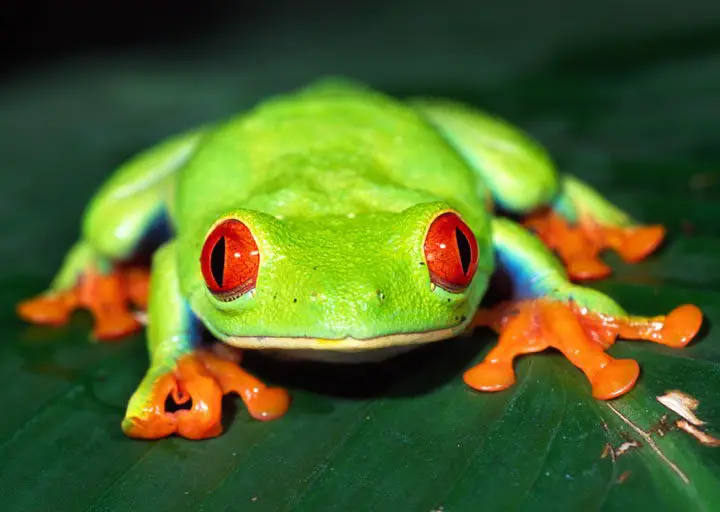
(Green Tree Frog)
Amphibians are
cold-blooded vertebrate animals of a class that comprises the frogs, toads,
newts, and salamanders. They are distinguished by having an aquatic
gill-breathing larval stage followed (typically) by a terrestrial
lung-breathing adult stage.
Amphibians lay
their eggs in water, and young amphibians tend to resemble small fish. The
tadpole, or newborn frog, is born and lives in water. It has a tail that allows
it to swim like a fish. It also has gills so that it can breathe under water.
As the tadpole grows into a frog, it loses its gills and tail, and develops
legs for moving on land. Most amphibians can both walk and swim in water. Depending
on the species of amphibian, breathing can take place in gills, lungs, the
lining of the mouth, the skin, or some combination of these. Amphibian’s body
temperature changes with its environment. In cold climates, amphibians
hibernate during the winter.
Traits
-
Their skin is smooth and slimy.
-
Breathe through their skin, as
well as their lungs in some cases.
-
Cold-blooded.
-
Complex life cycle (larval and
adult stages).
-
Many species of amphibians
vocalize.
-
Some species fertilize eggs
externally, some internally.
Subclass
Anura : This includes frogs and
toads
They usually
have long hind limbs that fold underneath them, shorter forelimbs, webbed toes
with no claws, no tails, large eyes and glandular moist skin. The ones with
smooth skins are commonly referred to as frogs, while those with warty skins
are known as toads.
Caudata : This includes salamanders.
The salamanders
are elongated, low-slung animals that mostly resemble lizards in form. This is
a symplesiomorphic trait and they are no more closely related to lizards than
they are to mammals. Salamanders lack claws, have scale-free skins, either
smooth or covered with tubercles, and tails that are usually flattened from
side to side and often finned.
Gymnophiona : This includes caecilians
Caecilians are
long, cylindrical, limbless animals with a snake or worm-like form. A
caecilian's skin has a large number of transverse folds and in some species
contains tiny embedded dermal scales. It has rudimentary eyes covered in skin,
which are probably limited to discerning differences in light intensity. Most
species lay their eggs underground and when the larvae hatch, they make their
way to adjacent bodies of water. Others brood their eggs and the larvae undergo
metamorphosis before the eggs hatch.
Anatomy
-
Amphibians have a skeletal
system that is structurally homologous to other tetrapods, though with a number
of variations. They all have four limbs except for the legless caecilians and a
few species of salamander with reduced or no limbs. The bones are hollow and
lightweight. The musculoskeletal system is strong to enable it to support the
head and body. The bones are fully ossified and the vertebrae interlock with
each other by means of overlapping processes. The pectoral girdle is supported
by muscle, and the well-developed pelvic girdle is attached to the backbone by
a pair of sacral ribs. The ilium slopes forward and the body is held closer to
the ground than is the case in mammals.
-
The lungs in amphibians are
primitive compared to those of amniotes, possessing few internal septa and
large alveoli, and consequently having a comparatively slow diffusion rate for
oxygen entering the blood. Ventilation is accomplished by buccal pumping. Most
amphibians, however, are able to exchange gases with the water or air via their
skin. To enable sufficient coetaneous respiration, the surface of their highly
vascularized skin must remain moist to allow the oxygen to diffuse at a
sufficiently high rate.
-
Many amphibians catch their
prey by flicking out an elongated tongue with a sticky tip and drawing it back
into the mouth before seizing the item with their jaws. Some use inertial
feeding to help them swallow the prey, repeatedly thrusting their head forward
sharply causing the food to move backwards in their mouth by inertia. Most
amphibians swallow their prey whole without much chewing so they possess
voluminous stomachs. The short esophagus is lined with cilia that help to move
the food to the stomach and mucus produced by glands in the mouth and pharynx
eases its passage. The enzyme chitinase produced in the stomach helps digest
the chitinous cuticle of arthropod prey.
-
For the purpose of reproduction
most amphibians require fresh water although some lay their eggs on land and
have developed various means of keeping them moist. In the tropics, many
amphibians breed continuously or at any time of year. In temperate regions,
breeding is mostly seasonal, usually in the spring, and is triggered by
increasing day length, rising temperatures or rainfall.
Species
The Red Eye Tree Frogs: Known for living on trees (duh) and have moist colored skin to help them camouflage to escape threats or hunting down foods.

Species
The Red Eye Tree Frogs: Known for living on trees (duh) and have moist colored skin to help them camouflage to escape threats or hunting down foods.
0 comments:
Post a Comment