Abi - 10 centaurus
Fishes are
vertebrates that have a skeleton made of either bone or cartilage. About 95% of
fishes have skeletons made of bone. These bony fishes have a swim bladder, a
gas-filled sac that they can inflate or deflate allowing them to float in the
water even when not swimming. Fishes with a cartilage skeleton tend to be
heavier than water and sink. They must swim to keep afloat. Cartilaginous
(cartilage) fish include the ray and the shark.
Almost
three-fourths of the world's surface is covered in water. This water is home to
over 20,000 different species of fish. The earliest fossils of fish date back
over 400 million years. Most fish breathe through gills. Gills perform the gas
exchange between the water and the fish's blood. They allow the fish to breathe
oxygen in the water.

(Goldfish)
Traits
-
Fish live in water.
-
Fish have a backbone; they are
vertebrates.
-
Fish breathe using gills. They
absorb oxygen through the gills.
-
Almost all fish are
cold-blooded.
-
Some fish have scales.
Anatomy
-
Most fish exchange gases using
gills on either side of the pharynx. Gills consist of threadlike structures
called filaments. Each filament contains a capillary network that provides a
large surface area for exchanging oxygen and carbon dioxide. Fish exchange
gases by pulling oxygen-rich water through their mouths and pumping it over
their gills. In some fish, capillary blood flows in the opposite direction to
the water, causing countercurrent exchange. The gills push the oxygen-poor
water out through openings in the sides of the pharynx. Some fish, like sharks
and lampreys, possess multiple gill openings. However, bony fish have a single
gill opening on each side. This opening is hidden beneath a protective bony
cover called an operculum.
-
Most fish swim using a tail
fin. Muscles in the tail fin move it from side to side, forcing water backward,
and propelling the fish forward. Other fins help the fish change direction and
stop. Pectoral fins on their side help them swim up and down. Dorsal and anal
fins on the top and bottom keep the fish upright. Pelvic fins on the underside
help steer left and right.
-
Jaws allow fish to eat a wide
variety of food, including plants and other organisms. Fish ingest food through
the mouth and break it down in the esophagus. In the stomach, food is further
digested and, in many fish, processed in finger-shaped pouches called pyloric
caeca, which secrete digestive enzymes and absorb nutrients. Organs such as the
liver and pancreas add enzymes and various chemicals as the food moves through
the digestive tract. The intestine completes the process of digestion and
nutrient absorption.
Species
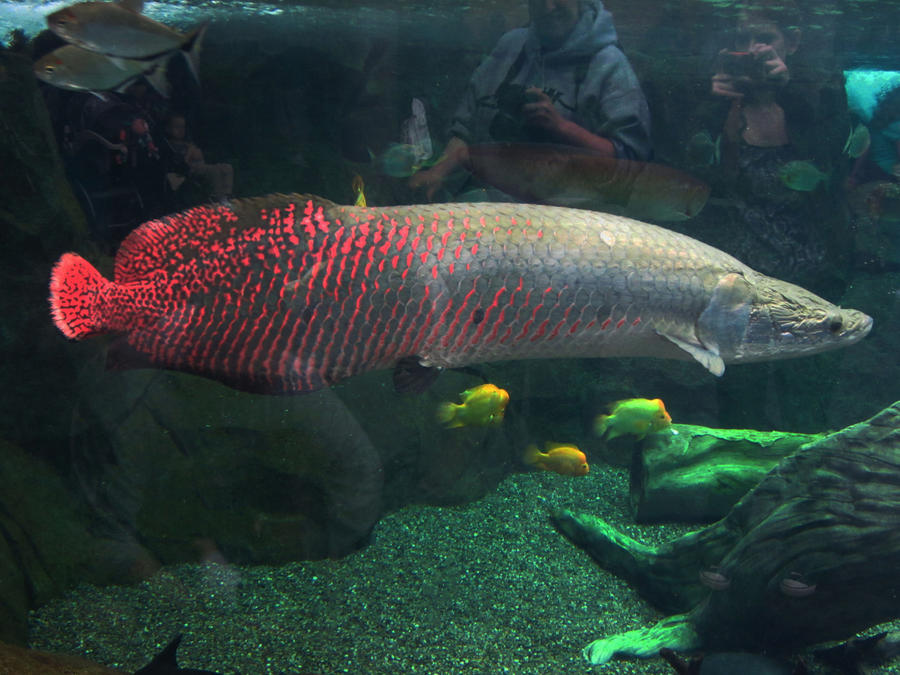
The Arapaima Fishes: Known as the biggest fishes in the Amazon rivers and known for it's gradient-colored scales.
0 comments:
Post a Comment