Cnidaria
Aget
Cnidaria is a group made up of more than 9,000 living species. Mostly
marine animals, Cnidaria include the corals, hydras, jellyfish, Portuguese
men-of-war, sea anemones, sea pens, sea whips, and sea fans. The word Cnidaria
refers to Cnidocysts specialised cells which contain the Nematocysts, the
stinging organelles that allow the Cnidaria to subdue their prey this is what
makes the cnidarian phylum special. All cnidarians share these common
characteristic:
-
Radially
Symmetrical.
-
Eukaryotic
and multicellular
-
Cnidarias
have an internal sac for digestion which is called the gastrovascular cavity.
The gastrovascular cavity has only one opening, a mouth, through which the
animal takes in food and releases waste
-
Mostly
carnivorous otherwise filter feeders. If carnivorous they use nematocysts to
hunt prey.
-
Have
specialized cells known as the nematocysts, a stinging organelle.
Their life cycle would start from an egg that has been fertilized by
sperms. The fertilized egg would later on develop itself to a Planuta (larva stage) the planuta has cilia hairs surrounding its
body to move around. Once the Planuta
finds a perfect place to stay in like rocks they would turn into polyps. Polyps
are U shaped and has a mouth with tentacles around it. Polyps can also form a
colony where collected food will be shared among the colony members.
The polyp clones itself and grows, once it’s ready to bud it is known as
a strobili. Then a clone of the polyp that has grown will bud off or fall off
form the top of the polyp, this clone polyp is known as an Ephyra. Ephyras are like
really-really tiny jelly-fish. The Ephyra
would develop itself feeding by using its tentacles and nematocysts and grow into a fully
matured Adult Medusa (adult
jellyfish), medusa are bell-like shaped with tentacles and a gastrovascular
cavity inside the “bell”. The adult medusa will eventually produce gametes and
the cycle start all over again. But the medusa state is not available in the Anthozoa class, which only depend upto
the Ephyra. The Ephyra of the Anthozoa
would move to another place and settle and eventually produce a poly and the
cycle starts all over again for the Anthozoa
class.
The phylum Cnidaria is made up of four classes: Hydrozoa (hydrozoans);
Scyphozoa (scyphozoans); Anthozoa (anthozoans); and Cubozoa (cubozoans).
Hydrozoa
Hydrozoans (hydroids) include
the Portuguese man o’ war, freshwater hydra, and hydroids such as “snail fur,”
which is commonly found on shells occupied by hermit crabs. In colonial forms,
the polyps bud, but stay attached and share continuous body layers. However,
individual members of the colony can perform different tasks, such as capturing
prey, digestion and reproduction. Hydrozoans is a polypoid shape, U shaped with
tentacles on top.
Hydractinia echinata or also
known as snail fur
(for image click here)
Scyphozoa
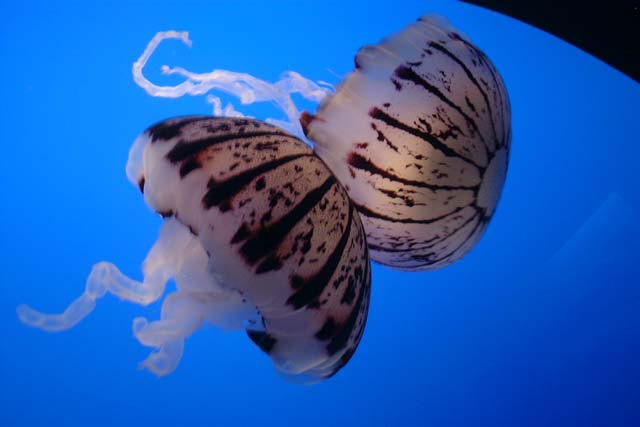
Scyphozoans are commonly known
as “jellyfish” because the medusa is the dominant form in the life cycle. Most
Scyphozoans are marine animals that live in shallow water. They have long
tentacles that has lots of nematocysts on it which is used to stun preys.
Anthozoa
Anthozoans (anemones and
corals) are mostly all bottom dwelling animals, in a polypoid shape. This means
that they live attached to the bottom with their tentacles and mouth pointing
up.
Example of this class:
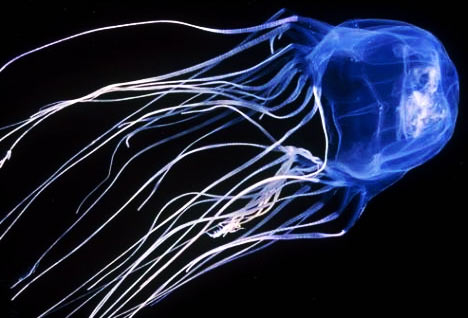
Cubozoans
Example of this class:
Bibiliography
Kennedy, J. (n.d.). Cnidaria -
What Is Cnidaria. Retrieved January 24, 2015, from http://marinelife.about.com/od/glossary/g/cnidarian.htm
Programs and Classes. (n.d.).
Retrieved January 24, 2015, from
http://www.neaq.org/education_and_activities/teacher_resources/classroom_resources/teacher_guides/jellies_teacher_guide/jellies_information_sheets/what_is_a_jelly.php
The Phylum Cnidaria. (n.d.).
Retrieved January 24, 2015, from http://www.earthlife.net/inverts/cnidaria.html
0 comments:
Post a Comment